

A BPMN (Business Process Model and Notation) diagram is a standardized flowchart method used to visually map out end-to-end business workflows. Maintained by the Object Management Group (OMG), BPMN 2.0 provides a universal language that bridges the gap between business analysts who design processes and software engineers who implement or automate them.
Unlike general flowcharts, BPMN has strict syntax rules and can be parsed directly by execution engines (like Camunda or Zeebe) to automate business processes.
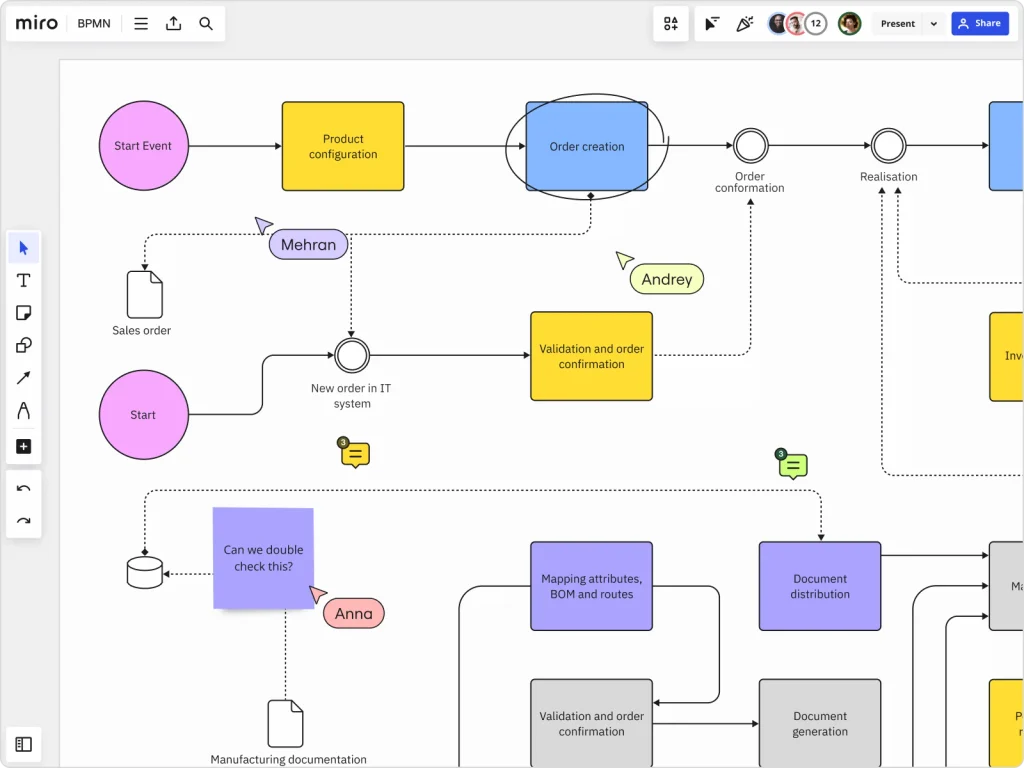
Core BPMN Elements
BPMN diagrams rely on four basic categories of elements:
1. Flow Objects (The Core Logic)
- Events (Circles): Represent something that happens during a process.
- Start Event (Thin border): Triggers the start of a process (e.g., Order Received).
- Intermediate Event (Double border): Happens mid-process (e.g., Wait 30 Days, Error Caught).
- End Event (Thick border): Signals process completion (e.g., Invoice Paid).
- Activities (Rounded Rectangles): Represent work being performed.
- Task: A single unit of work (e.g., Validate Payment).
- Sub-process: A complex activity containing its own nested BPMN flow.
- Gateways (Diamonds): Control sequence flow branching, merging, and decisions.
- Exclusive (XOR): Only one path can be taken based on conditions.
- Parallel (AND): All path branches execute concurrently.
- Inclusive (OR): One or more branches can be taken based on evaluated conditions.
2. Connecting Objects
- Sequence Flow (Solid Line with Solid Arrowhead): Shows the execution order of activities within the same process.
- Message Flow (Dashed Line with Open Circle/Arrowhead): Shows communication crossing organizational or process boundaries (between different Pools).
- Association (Dotted Line): Links artifacts or data objects to activities.
3. Swimlanes (Organizational Context)
- Pool: Represents a major participant, organization, or distinct process context (e.g., Customer Pool vs. Vendor Pool).
- Lane: A sub-partition within a Pool used to categorize tasks by department, role, or system component (e.g., Sales Dept, Billing System).
4. Artifacts & Data
- Data Object: Represents inputs or outputs required/produced by activities (e.g., Order PDF).
- Data Store: Represents persistent storage (e.g., Database).
Key Use Cases
- Process Documentation & Analysis: Auditing current workflows (As-Is) to identify bottlenecks, redundant steps, and automation targets (To-Be).
- Workflow Automation: BPMN 2.0 specs export to XML formats that workflow execution engines run as live microservices.
- Cross-Functional Alignment: Serving as a shared visual contract across domain experts, product managers, and software engineers—complementing Domain-Driven Design (DDD) bounded context mappings.
Why to use BPMN and when
Using BPMN (Business Process Model and Notation) provides a rigorous way to design, communicate, and automate business logic. For software architects and engineering teams, BPMN bridges the gap between abstract business requirements and concrete technical implementation.
Why Use BPMN? (The Benefits)
- Eliminates Ambiguity (A Universal Standard): Ad-hoc flowcharts use random shapes and colors that mean different things to different people. BPMN is an ISO standard (ISO/IEC 19510). Every symbol—from an exclusive gateway to an intermediate message event—has a precise semantic meaning agreed upon globally.
- Executable Specifications (Models Are Code): Unlike static documentation that rots in a wiki, BPMN 2.0 XML files can be parsed directly by workflow engines (like Camunda, Zeebe, or Flowable). The diagram is the executable process definition, reducing translation errors between system design and implementation.
- Explicit Hand-offs and Boundaries: Swimlanes and message flows make clear who (or what system) is responsible for each action. This aligns naturally with Domain-Driven Design (DDD) and Event Storming, making it easy to identify where Bounded Contexts interact and where domain events are triggered.
- Built-in Error and Exception Handling: BPMN allows you to explicitly model edge cases—such as timeouts, compensation logic (rollbacks), and error catch events—ensuring robustness before writing code.
When to Use BPMN?
BPMN is not meant for every software problem, but it shines in specific architectural scenarios:
- Long-Running, Stateful Workflows (Orchestration): Use BPMN when a process spans hours, days, or weeks and must maintain state across system restarts (e.g., loan approvals, supply chain logistics, insurance claims processing, or onboarding workflows).
- Distributed Sagas and Complex Compensations: When coordinating a distributed transaction across multiple microservices where you need explicit rollback/compensation steps if a step fails midway.
- Cross-Departmental / Cross-System Integration: When a workflow requires hand-offs between human tasks (manual reviews) and automated system tasks (API calls, background workers).
- Auditing and Compliance: In heavily regulated industries (finance, healthcare, logistics), BPMN models serve as auditable system specifications that satisfy compliance and legal reviews.
When Not to Use BPMN
- Simple CRUD Operations & UI Navigation: If your application is standard request-response data entry or basic screen routing, BPMN is massive overkill.
- Purely Event-Driven Choreography: If your architecture relies entirely on decoupled services reacting to asynchronous events on a message broker (e.g., Kafka) without a central coordinator, a centralized BPMN orchestrator introduces unnecessary coupling.